Have you ever had a sinus infection that just won't seem to go away? And no matter how many nasal sprays, antibiotics, or home remedies you try, your symptoms continue to stick around?
If so, you may have a condition called chronic rhinosinusitis (CRS).
CRS is one of the most common chronic medical conditions, estimated to affect about 10% of people worldwide.¹ It's a condition seen in people of all ages, and it's the fifth most common reason antibiotics are prescribed.²
For many patients, CRS is more than occasional runny noses and sinus pressure. Instead, symptoms like congestion, facial pressure, fatigue, and recurrent infections can significantly affect daily life, sleep, and overall well-being.
What makes CRS especially frustrating is that standard testing and treatments often miss the underlying cause for many patients. This leaves patients struggling with these unpleasant symptoms for years.
In this blog, we'll discuss what CRS is, what causes it, how it's diagnosed and treated, and how tests like MicroGenDx molecular testing can help you finally get relief.
What Is Chronic Rhinosinusitis?
Our noses and sinuses allow us to do much more than smell. When they're functioning properly, they allow air to flow and be filtered for viruses, bacteria, and other toxins when we breathe. These substances are then cleared from the body when the sinuses drain.
However, if the nasal cavities and sinuses are inflamed for long periods of time, this process is affected and can cause blockages in the sinuses. When the sinuses can't properly drain, bacteria, viruses, and even fungi can build up, leading to infection, and worsening inflammation.²
This leads to symptoms such as nasal congestion, facial pressure, and recurrent sinus infections. When these symptoms and inflammation are present for 12 weeks or longer, the condition is commonly referred to as CRS.¹
It's important to note that CRS is much different than a typical sinus infection. In fact, there are several different types of rhinosinusitis, and each type is classified based on how long symptoms last:
Acute: Usually caused by a viral or bacterial infection, such as the common cold, and lasts less than four weeks. These cases affect as many as 4% of U.S. adults depending on the location and season.
Subacute: Symptoms last between four and 12 weeks.
Chronic: Symptoms persist for 12 weeks or longer and are often caused by bacteria or fungi.
Recurrent: Multiple episodes occur each year, with each episode lasting less than 2 weeks.
So what exactly causes rhinosinusitis to become chronic?
The Causes and Risk Factors of Chronic Rhinosinusitis
Most cases of CRS are multifactorial and often involve a combination of inflammation, infection, nasal structure, and environment. Recent research shows that CRS develops through a complex interaction between a person's environment and their immune system.
When the protective mucosal barrier inside the nose and sinuses gets damaged, the immune system responds by sending fighter cells to the area. This temporary response increases inflammation to fight off any harmful organisms or invaders.
In CRS, however, instead of a temporary immune and inflammatory response, the response becomes ongoing. This leads to chronic inflammation and structural changes to the nasal cavities and sinuses over time.
One of the changes that can happen in the sinuses during this process is the formation of biofilms. Biofilms are organized communities of bacteria or fungi that attach to the sinus lining and surround themselves with a protective coating.
This protective coating allows the organisms to hide from the immune system, making them much harder to get rid of with standard treatment. It also makes biofilm-associated organisms difficult to detect with standard testing and cultures.
As a result, biofilms often cause persistent infection, worsen inflammation, and contribute to many of the ongoing symptoms seen in CRS.
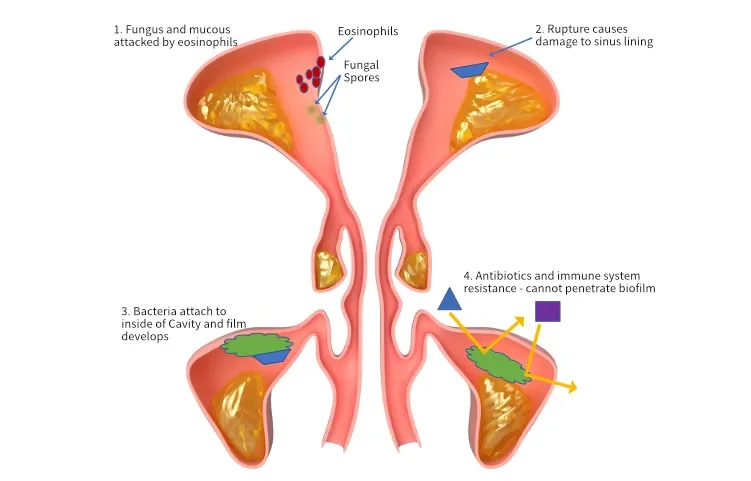
A diagram of how CRS develops.³
In addition to biofilms, many other factors can contribute to the development of CRS, including:⁴
Allergic inflammation of the nasal lining (can be from dust mite and molds)
Lower respiratory tract diseases like asthma
Immune deficiencies
Gastroesophageal reflux disease (GERD)
Structural issues in the nose (like a deviated septum)
Infectious organisms like bacteria, viruses, and fungi
Damage to the cilia (hair-like structures) in the nose that help clear mucus
Smoking
Air pollution
Obstructive sleep apnea (OSA)
Metabolic syndrome
Low vitamin D3 levels
Genetic factors
Together, these factors can disrupt the healthy functioning of the nose and sinuses, which increases the risk of developing CRS.
What Are the Symptoms of Chronic Rhinosinusitis?
Because of all of the different possible causes of CRS, symptoms vary from person to person. The most common symptoms of CRS are:²
Drainage from the nose that's green or yellow
Facial pain that feels like aching, fullness, or pressure
Feeling a blockage or obstruction in the nose, which can cause difficulty breathing or mouth breathing
Other symptoms of CRS include:
Loss of smell (Hyposmia)
Headache
Ear pain
Bad breath (Halitosis)
Tooth pain
Cough
Fatigue
Because these symptoms can overlap with other nasal and respiratory conditions, symptoms alone aren't enough to diagnose CRS. Proper evaluation and testing are needed to confirm the diagnosis and guide treatment.
How is Chronic Rhinosinusitis Diagnosed?
CRS is diagnosed using a combination of the symptoms you have and testing. In order to be diagnosed with CRS, you must have two or more of the following symptoms lasting for 12 weeks or longer:⁵
Nasal blockage
Runny nose
Facial pain/pressure
Impaired sense of smell
Additionally, you must have evidence of nasal cavity and/or sinus inflammation on at least one of these tests:
Nasal endoscopy (where a small camera is used to look up into the nose and sinuses)
CT imaging (CAT scan) of the sinuses
Sometimes, other imaging like MRI may be used instead of a CT scan. This is commonly done with children to avoid radiation exposure, as MRIs don't expose patients to radiation.
Treatment Options for Chronic Rhinosinusitis
Treatment for CRS usually focuses on lowering inflammation, improving sinus drainage, and addressing any underlying contributing factors like allergies or infection.
| Medication Type | Example | How it Works |
|---|---|---|
| Nasal steroid sprays | Flonase, Nasonex | Lowers inflammation in the nasal passages, which improves airflow and mucus drainage. Helpful in most cases. |
| Antihistamines | Zyrtec, Claritin | Decreases the body's allergic response, which helps to improve inflammation and symptoms of CRS. Helpful only in cases when allergies are suspected to contribute. |
| Nasal saline rinsing | Neti pot, water pick with an irrigation tip, squeeze bottle. You can make your own saline or mix sterile water with premixed packets. | Thins and flushes out mucus, irritants, and allergens while helping to moisturize and clean the sinuses. Can be helpful in most cases. |
| Oral steroids | Prednisone | A short course may be used in more severe cases to quickly reduce swelling and improve symptoms. |
| Antibiotics | Antibiotic choice varies but is typically chosen based on what bacteria are growing in the nasal cavities/sinuses. If antibiotics are used to decrease inflammation, azithromycin is commonly used.6 | May be prescribed when a bacterial infection is suspected. Antibiotics may be used either short term for acute infections (<3 weeks) or long term to help lower inflammation (>3 weeks). |
| Surgery | Functional Endoscopic Sinus Surgery | Considered when patients don't improve with medical treatment or when structural issues (like a deviated septum or blocked sinus openings) prevent proper sinus drainage. Surgery involves removing tissue to improve air flow and drainage in the nasal cavities and sinuses. |
While many of these treatment options help improve symptoms, many people with CRS don't have complete relief because the specific organisms causing the immune response and inflammation are never identified.
This is where more advanced diagnostic tools like MicroGenDx molecular testing can help guide more targeted, successful treatment.
MicroGenDx Testing for Chronic Rhinosinusitis
When standard testing and cultures are unable to get to the root cause of CRS, advanced molecular testing like MicroGenDx is often a great next step.
What is MicroGenDx Testing?
MicroGenDx is an advanced type of testing that identifies organisms like bacteria, viruses, and fungi by analyzing their DNA. Instead of waiting for organisms to grow in a lab, like with a standard culture, MicroGenDx uses PCR and next-generation DNA sequencing to detect organisms directly.
MicroGenDx can be used to identify disease-causing organisms all over the body. But when used in cases of CRS, we can use MicroGenDx testing to find out if an infection is causing the chronic inflammation in the sinuses.
How Does MicroGenDx Testing Work?
To get a MicroGenDx test, it must be ordered by a healthcare provider. Getting the test done is simple and involves collecting a small swab from your nose. At our office, Wisdom Way Medicine, this can typically be done at a routine office visit.
The sample is then sent to the MicroGenDx laboratory for analysis. Typically, within 24 hours of the lab receiving your sample, we'll know the exact organisms that are contributing to your CRS.
How MicroGenDx Differs from Standard Cultures
Standard cultures involve taking a nasal swab and growing it on a petri dish in a lab. These types of cultures often miss the real sources of infection because many bacteria and fungi don't grow well outside of the body. MicroGenDx avoids this problem by detecting the DNA of the organisms, which allows identification of nearly all of the organisms present.
MicroGenDx testing can identify up to 60,000 different types of bacteria and fungi. Plus, testing shows how much of each microbe is present and if any bacteria are resistant (unable to be treated by) certain antibiotics. This can help us understand which organisms are most likely contributing to symptoms.
How MicroGenDx Improves Treatment for Chronic Rhinosinustitis
By showing the exact organisms present in the nasal cavities and sinuses, MicroGenDx can help your healthcare provider choose treatments that are more likely to work. Instead of relying on broad-spectrum antibiotics or antibiotics used to cover "typical" organisms that cause disease in the sinuses, treatment can instead be chosen based on the specific organisms involved.
Using this approach can:
Lower unnecessary medication use
Reduce risk of antibiotic resistance
Improve results for those who haven't responded to standard treatments
In many of my patients with CRS, I've seen that a fungal infection, commonly from mold, is the underlying cause—not bacteria. Most standard cultures miss this completely, but MicroGenDx testing can be used to properly diagnose this and guide treatment.
When is MicroGenDx Testing Appropriate for Chronic Rhinosinusitis?
MicroGenDx testing is helpful for people who:
Still have symptoms of CRS after multiple rounds of antibiotics
Have negative or unclear results from standard cultures
May have fungal or biofilm involvement
Need guidance on the most effective treatment regimen for their condition
Want a more precise, personalized treatment approach
Cost of MicroGenDx Testing
The cost of MicroGenDx testing varies depending on the type of test ordered, whether you use insurance, and the health provider who orders the test. In some cases, insurance may cover part or all of the cost, but this depends on your specific health insurance plan and the reason for testing.
If insurance doesn't cover the cost of testing, paying out-of-pocket is an option. For the test used to evaluate CRS, the average cost is $259.
How Can I Get A MicroGenDx Test For Chronic Rhinosinusitis?
If you've been struggling with CRS and feel like nothing has truly gotten to the root of the problem, MicroGenDx testing may be a good next step for you - even if you've had symptoms for years. This advanced testing is offered at our office, Wisdom Way Medicine in Portland, OR, and can be completed during an office visit.
Once results are available, they're reviewed with you and used to guide a more targeted, effective treatment plan. For people with CRS, identifying the underlying cause is an important step toward improving symptoms and managing the condition.
To learn more about MicroGenDx testing for CRS or to schedule an appointment, please use the link below.
FAQ: Chronic Rhinosinusitis and MicroGenDx Testing
-
Yes, there are several risk factors for CRS. These include allergies, asthma, immune deficiencies, and environmental exposures and toxins. Structural issues like a deviated septum can also increase the risk of CRS as it can block proper sinus drainage and increase the risk of chronic inflammation.
-
Yes, excess sinus drainage can upset the stomach when swallowed. This can sometimes lead to nausea, abdominal discomfort, or diarrhea, especially during acute infections.
-
Chronic sinusitis and CRS may improve with proper treatment, but complete resolution of the condition requires finding the underlying cause. Once the underlying cause is identified, targeted treatment can begin.
-
A humidifier may help the symptoms of patients with chronic sinusitis and CRS by keeping nasal passages moist and improving mucus drainage. However, using a humidifier doesn't treat the underlying cause.
-
Sinusitis refers to inflammation of the sinuses, typically from infection, allergens, or other irritants. Acute sinusitis lasts less than four weeks, subacute sinusitis lasts between four and 12 weeks, and chronic sinusitis lasts 12 weeks or longer. Recurrent sinusitis refers to multiple separate episodes of acute sinusitis occurring several times per year.
References:
1. Mechanisms and pathogenesis of chronic rhinosinusitis – (nih.gov)
2. Chronic Sinusitis – (nih.gov)
3. What Makes Chronic Sinusitis “Chronic?” – (citrisafe.com)
4. Chronic rhinosinusitis: A narrative review of predisposing factors and their relationships with endotypes – (sciencedirect.com)
5. The Diagnosis and Treatment of Chronic Rhinosinusitis – (nih.gov)
6. Chronic Rhinosinusitis Without Nasal Polyposis: Management and Prognosis – (uptodate.com)